What is a Land Use Bylaw (LUB)?
A Land Use Bylaw is the primary regulatory tool that governs land use and development within a municipality ensuring an orderly and efficient pattern of development.
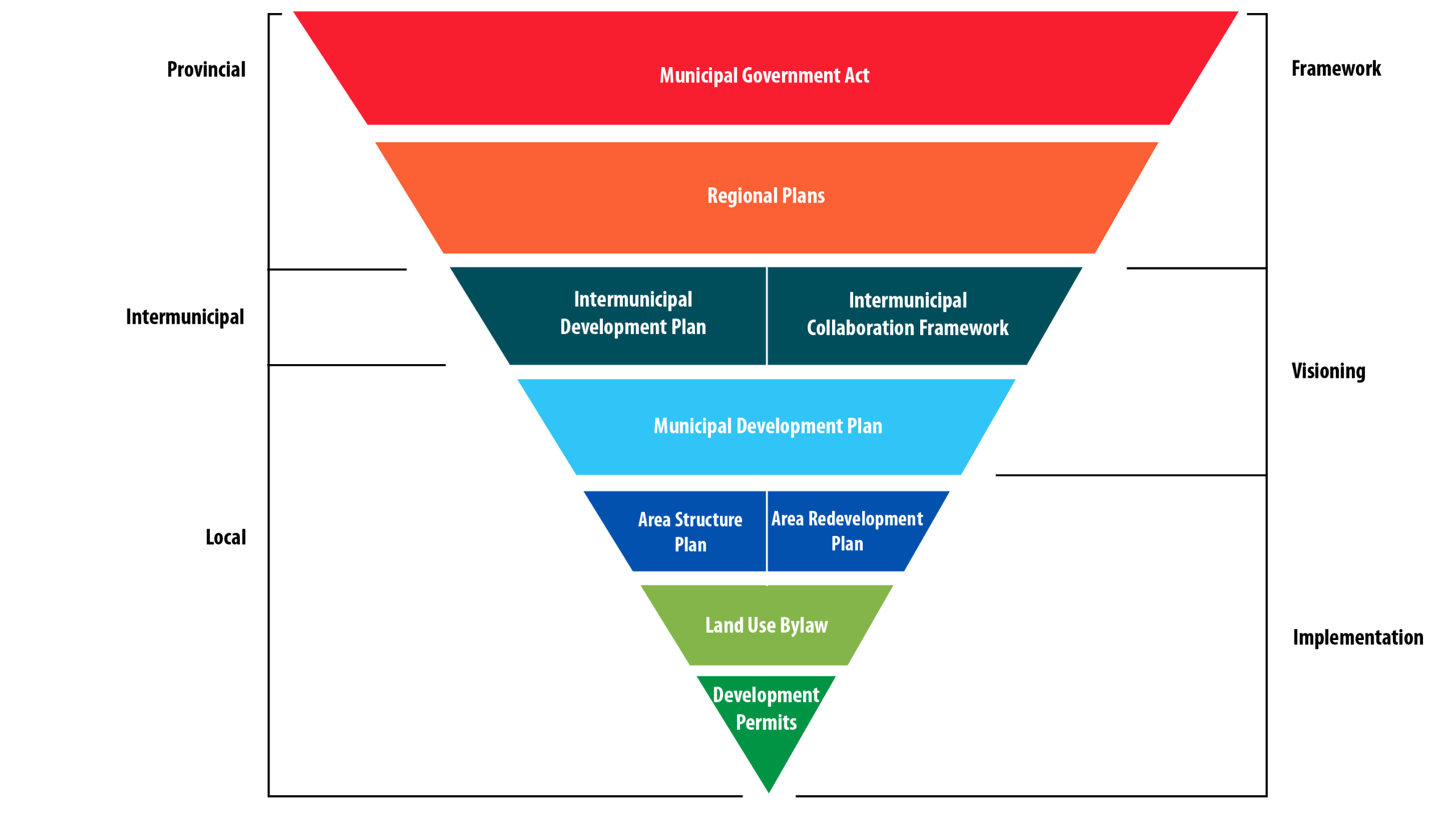
It creates consistency and equity across Innisfail regardless of property location. It outlines the procedures for reviewing and deciding on development permit applications.
Additionally, it provides mechanisms for enforcing regulations, helping to create clarity and fairness for all landowners and developments.
Land Use Bylaws are often referred to as Zoning Bylaws.
What is a Land Use Bylaw for?
A Land Use Bylaw is a bylaw adopted by Council that ensures:
(a) Landowners have certainty on what can and cannot be built on their property (or their neighbour’s property).
(b) Maintains a balance between development interests and the interests of residents for the common good in Innisfail.
Why Update the Land Use Bylaw Now?
Updating the Land Use Bylaw reflects the following:
- Direction from the recently adopted Municipal Development Plan – imagineINNISFAIL;
- A land use bylaw should be reviewed and revised every five to ten years to ensure well-managed growth and development in a community. The existing bylaw was last reviewed in 2019. Click here to view the most recent version.
- Modernizing regulations and evolving development trends;
- Aligning with recent provincial legislation;
- Replacing outdated regulations that can increase costs and delays in the development process; and,
- Providing certainty about use definitions within each land use district.
Hot Topics
Housing
Innisfail’s population was 8,224 in 2021. In 2024, this had climbed to 8,714, an increase of 6%. In December 2025, it is estimated that Innisfail’s population is 8,760. Where is the increased population being housed?
In 2023, Innisfail had a 0.4% rental vacancy rate, this improved slightly in 2024 to 1.6%. A healthy apartment rental vacancy rate is between 3% and 5% which indicates a balanced market where there are enough available units to meet demand without being so scarce that it drives up rental prices excessively. Multi-unit development built specifically for rental purposes has been rare in Innisfail. Since 2012, only 92 rental units have been constructed despite an additional 838 people calling Innisfail home. A 27-unit apartment building is currently being rehabilitated, and units should be available in 2026.
Between 2012 and December 2025, 219 single detached or duplex dwellings have been constructed.
By comparison, the 2023 Housing Needs Assessment identified an estimated unmet demand for 27 single and semi-detached homes, 31 apartment units, row housing or movable dwellings, and 29 subsidized housing units as of that year. More importantly, this report identified that between 2026 to 2031, Innisfail will need 81 more dwelling units consisting of 55 or more single and semi-detached homes, 24 or more dwelling units in the form of apartment buildings or row housing and at least two (2) or more subsidized community housing units.
Secondary Suites
Secondary suites are a growing trend across Canada. As housing costs have risen, many Canadians are adding legal suites to their homes. Secondary suites can be created as basement or 'mother-in-law' suites within a home, as garage suites or stand alone backyard buildings.
Common concerns with allowing secondary suites in a community relate to the impact of additional vehicles, the construction of a second entrance, compliance with building standards, impact on the neighbourhood, and protecting property investment and value.
Innisfail, like most other municipalities in Alberta, classifies secondary suites as a discretionary use allowable in most detached dwellings or side-by-side duplexes. Some Albertan municipalities have begun to allow secondary suites within the end units of townhomes.
As a discretionary use, each application for a secondary suite must be reviewed by the Municipal Planning Commission. This adds to the review time on such an application and provides the opportunity for neighbours to appeal an approval.Accessory Buildings
An accessory building is any building on a site that is not the principal building. On residential lots this type of building is typically a detached garage, shed or greenhouse.
The current Land Use Bylaw allows accessory buildings to be 4.5 m (15 ft) tall and have a maximum size of 68 m2 (728 square feet). A 26' x 28' building would be 728 square feet.
Any applications that exceed these requirements require a variance that must be approved by the Municipal Planning Commission.
Driveways
The current regulations for RESIDENTIAL driveways are shown in section 3.23(3) of the Land Use Bylaw:
R-1A and Low Density (LDR) - maximum front driveway width 10.97 m (36 ft)
All other residential districts - maximum front driveway width 7.32 m (24 ft)
as measured at the point where the driveway crosses the parcel boundary onto the boulevard
Proposed Approach
For a RESIDENTIAL driveways the driveway may be the greater of 7.32 m (24 ft) or 60% of the parcel frontage to a maximum of 10.97 m (36 ft) AND the width of a driveway shall not exceed the width of the garage or carport to which the driveway provides access as shown in this figure:
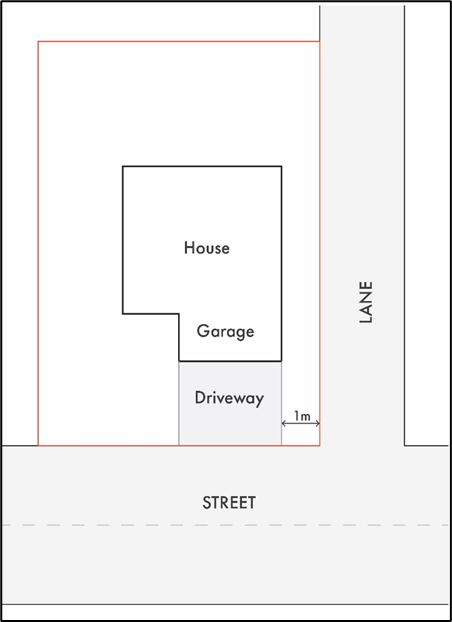
Increasing the width of a driveway may increase the amount of storm water entering storm drains possibly overloading them during extreme events and reduces the space available for street parking.
Notification Procedures for Decisions
When a Development Authority decides on a development permit application, there is a legislative requirement to “provide for how and to whom notice of the issuance of a development permit is to be given” [MGA RSA 2000 Chapter M-26, section 640(2)(d)].
The current notification process for development permits is shown below:
The town seeks to be open and transparent when it comes to decision making, especially in the development review process, while ensuring that permit processing times and use of staff time are efficient.
Is the current notification process adequate in informing residents about permit applications in their neighbourhoods?
Parking Pads
Most residential lots have a driveway leading to a garage where a vehicle is parked when not in use. Some, however, do not have driveways resulting in homeowners parking on the street or in the rear yard.
In some cases, homeowners have constructed parking pads in their front yard where they parked their vehicle. 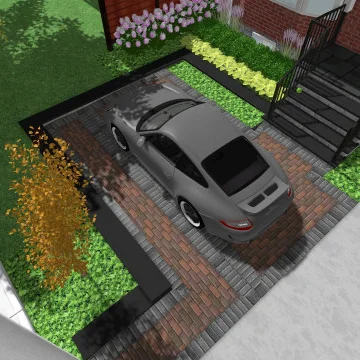 A parking pad is essentially a designated area, typically paved or surfaced, designed specifically for parking vehicles. Unlike traditional driveways, parking pads are usually smaller, more flexible in placement, and can be customized to fit various property layouts. They offer a convenient alternative for those seeking additional parking space without the need for extensive construction or major landscaping changes.
The current Land Use Bylaw prohibits the storage of a recreational vehicle or other vehicles in the front yard in any residential district if, in the opinion of the Development Authority, it is unsightly or tends to adversely affect the amenities of the surrounding area.
Wording in the proposed Land Use Bylaw explicitly states that front yard parking pads are not permitted in residential districts unless the neighbourhood has been designed to accommodate them in lieu of front or rear yard garages.